
How to Mix Keyboards With Heritage Audio: Piano, Synths and B3 Organ

Keyboards are unusually easy to overmix because they can cover almost the entire audible spectrum. A stereo piano can own the lows, mids and highs at once. A wide synth pad can occupy the same space as guitars and vocal effects. A B3 can fill the midrange so completely that nothing else has room.
The solution is not to make every keyboard small. The solution is to assign each keyboard a job, then use Heritage Audio processors to reinforce that job.
Quick Flow
|
Stage |
Plugin / Role |
Purpose |
|
Piano |
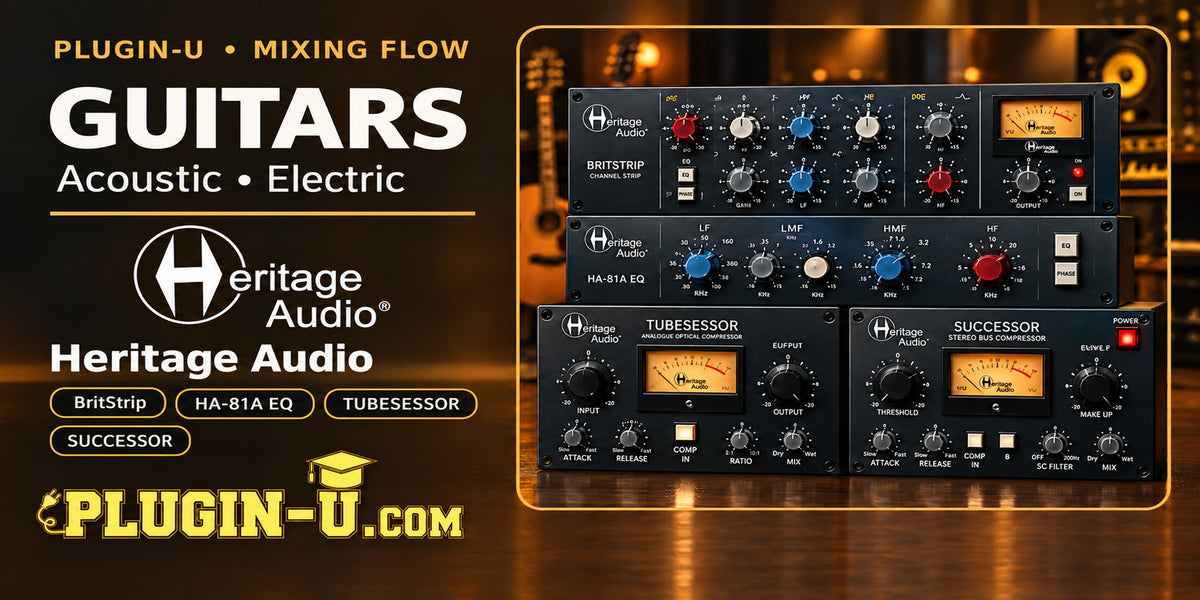
HA-81A EQ → TUBESESSOR |
Clean low mids, retain hammer attack, control performance |
|
Synths |
MOTORCITY EQ → optional HA 1200 |
Organize low/mid energy and add controlled tape density |
|
B3 |
BritStrip → TUBESESSOR |
Shape midrange and keep the organ dense without masking the lead |
|
Keys Bus |
SYMPH EQ |
Broad stereo or M/S finishing moves across the section |
1. Piano: HA-81A EQ First, Compression Second
Begin with the piano in the arrangement, not solo. If bass and kick already carry the low end, remove only the piano energy that is redundant. If the instrument is the harmonic center of a sparse arrangement, preserve more body.
Check the 200–500 Hz zone for boxiness and buildup. Small cuts often create room for vocal and guitar mids. For presence, listen around 2–5 kHz where hammer attack and definition live. Add carefully; aggressive boosts can turn a beautiful piano brittle.
If the performance has uneven dynamics, follow with TUBESESSOR. Let the initial hammer transient remain audible. The objective is to keep notes in a usable range, not turn a piano into a pad.
2. Synths: Use MOTORCITY EQ as a Musical Map
MOTORCITY EQ’s fixed-band concept encourages broad decisions instead of endless searching. Think of 50 and 130 Hz as weight, 320 Hz as congestion, 800 Hz as body or nasal character, 2 kHz as definition, 5 kHz as edge, and 12.5 kHz as sheen.
A large synth does not need to be impressive at every band. If it is a supporting pad, reduce the area that competes with the lead vocal. If it is the featured hook, make room elsewhere in the arrangement instead of stripping all of its personality.
An optional HA 1200 Tape Saturator stage can help soft digital synths feel more connected and less pristine. Use it for density, not as an excuse to add level.
3. B3 Organ: Control the Midrange Without Removing the Growl
B3 is primarily a midrange instrument in most rock, blues, soul and pop mixes. BritStrip gives you fast filtering, musical EQ and dynamics in one place.
Start by deciding whether the organ is a background bed or a featured part. For a bed, reduce the midrange area occupied by the vocal and guitars. For a feature, allow more bite and pull other elements back.
TUBESESSOR can smooth the apparent level of sustained organ parts and add useful density. Because the B3 already has rich harmonics, moderate processing is usually enough.
4. Put All Keyboards on a Bus and Finish With SYMPH EQ
Route piano, synths and organ to a stereo keyboard bus. Once the internal balance works, use SYMPH EQ for broad finishing moves.
The M/S capability is useful on wide keyboard arrangements. You can keep the center comparatively stable while shaping the sides, which can preserve vocal focus without collapsing stereo width.
Do not use the bus EQ to fix one badly balanced keyboard. Fix the source first, then make broad section-wide moves.
5. Use Vintage Effects Selectively
TAPEoPLEX can add rhythmic movement to synths or organ without flooding the mix with reverb. HA 240 Gold Foil Verb is useful when the keys need a darker, vintage ambience.
Choose one obvious spatial identity per keyboard part. If the piano, pad and B3 each have long independent reverbs, the result is usually depth without definition.
Useful Starting Points
- Piano: high-pass only as needed; check 200–500 Hz for buildup; preserve the 2–5 kHz attack zone unless it is genuinely harsh.
- Synth: decide which of MOTORCITY EQ’s broad bands belongs to the arrangement and leave the rest alone.
- B3: shape the midrange around the vocal/guitar arrangement; use moderate compression and let the rotary/organ character stay intact.
- Keys bus: use SYMPH EQ for broad tonal balance or M/S width decisions—not surgical repair.
What to Listen For
- The vocal remains centered and intelligible when all keyboards play.
- The piano still has believable hammer attack and body.
- Synth pads feel wide without making the center cloudy.
- The B3 growls when it should but does not dominate every midrange frequency.
Common Mistakes
- EQing each keyboard to sound huge in solo.
- Applying identical high-pass settings to piano, synth and organ.
- Overcompressing piano transients.
- Using stereo widening before fixing masking in the center.
|
Plugin-U Takeaway |
|
Next Step |

Leave a comment
This site is protected by hCaptcha and the hCaptcha Privacy Policy and Terms of Service apply.