
Stock vs Premium Plugins: When Is It Worth Spending Money on Third Party Plugins?

Modern DAWs now ship with highly capable stock plugins for EQ, compression, delay, reverb, saturation, and utility processing. At the same time, premium plugin developers continue refining analog modeling, workflow efficiency, harmonic realism, and mastering-grade processing.
The conversation is no longer about whether stock plugins can create professional mixes. They absolutely can.
The real difference is usually workflow, tone, flexibility, and how plugins behave under heavier processing conditions.
Plugin-U.com is a platform where students may be able to purchase selected audio software with possible educational discounts depending on manufacturer eligibility and availability.
EQ Plugins
Modern stock EQs are technically excellent for corrective work, but premium EQs often separate themselves through workflow speed, dynamic processing, and analog-style tonal shaping.
|
Plugin |
Why Engineers Use It |
|
FabFilter Pro-Q 4 |
Industry-standard workflow for surgical EQ, dynamic bands, and fast visual correction. |
|
Kirchhoff-EQ |
Detailed filter behavior with mastering-grade flexibility and analog-style musicality. |
|
UAD Pultec Collection |
Widely used for low-end enhancement and broad musical tone shaping. |
|
Weiss EQ MP |
Extremely transparent tonal balancing for mastering applications. |
|
SSL Native X-EQ |
Console-style tonal shaping and broad musical balance adjustments. |
Stock EQs are often more than capable for cleanup work. Premium EQs usually become more valuable in larger sessions where workflow speed and tonal flexibility matter more.
Compression Plugins
Compression is one area where premium plugins still separate themselves very clearly from stock processors.
|
Plugin |
Why Engineers Use It |
|
UAD 1176 Collection |
Fast FET compression with aggressive transient control and classic analog vocal character. |
|
Tube-Tech CL 1B |
Smooth optical compression heavily used in modern vocal mixing. |
|
Empirical Labs Distressor |
Extremely versatile compression for vocals, drums, and mix buses. |
|
SSL Bus Compressor |
Adds mix cohesion and “glue” across stereo buses. |
|
Shadow Hills Mastering Compressor |
Popular for mastering depth and analog-style bus tone. |
Stock compressors can absolutely control dynamics effectively, but premium compressors usually offer smoother harmonic behavior and more musical response under heavier gain reduction.
Saturation and Analog Modeling
This is one of the biggest upgrade areas between stock and premium plugins.
Modern commercial mixes rely heavily on harmonic enhancement, analog texture, and transient density.
|
Plugin |
Why Engineers Use It |
|
Soundtoys Decapitator |
Aggressive harmonic coloration and analog-style vocal character. |
|
Black Box Analog Design HG-2 |
Smooth tube harmonics and polished mix-bus enhancement. |
|
FabFilter Saturn 2 |
Flexible multiband saturation and harmonic shaping. |
|
Softube Tape |
Tape-style cohesion and smoother transient response. |
|
Slate Digital Virtual Tape Machines |
Adds analog-style density and low-end movement. |
For example:
- Decapitator is commonly used for more aggressive vocal coloration,
while - HG-2 is usually preferred for smoother harmonic enhancement and mastering-style polish.
Reverb and Spatial Processing
Stock reverbs have improved significantly, but premium reverbs still tend to create more polished depth, modulation, and stereo imaging.
|
Plugin |
Why Engineers Use It |
|
Valhalla VintageVerb |
Dense vocal ambience and smooth modulation. |
|
LiquidSonics Seventh Heaven |
Highly realistic spatial depth and room modeling. |
|
Relab LX480 |
Lexicon-style modulation and polished stereo ambience. |
|
Eventide Blackhole |
Large atmospheric spaces and cinematic movement. |
|
FabFilter Pro-R 2 |
Modern reverb workflow with detailed shaping controls. |
Premium reverbs usually become more noticeable in:
- vocal production,
- cinematic mixing,
- ambient production,
- and larger commercial arrangements.
Mastering Plugins
Mastering is another area where premium plugins often provide stronger metering, limiting, tonal control, and workflow precision.
|
Plugin |
Why Engineers Use It |
|
FabFilter Pro-L 2 |
Transparent limiting with excellent loudness and true-peak metering. |
|
iZotope Ozone 12 |
Complete mastering workflow with dynamics, EQ, imaging, and limiting tools. |
|
DMG Audio Limitless |
Advanced multiband limiting and transient management. |
|
sonible smart:limit |
Intelligent loudness control with transparent limiting behavior. |
|
ADPTR MetricAB |
Professional reference comparison and tonal-balance analysis. |
Stock mastering tools can still work well, but premium mastering plugins usually provide better workflow visibility and more advanced control during final delivery stages.
Premium plugins make the most sense when they provide a workflow, sound or capability your stock tools do not provide efficiently. Current Plugin-U examples include Baby Audio Smooth Operator Pro for dynamic spectral problem-solving, Heritage Audio Britstrip for console-style channel processing and Heritage Audio HA 1200 for tape-style saturation.
So When Is It Actually Worth Upgrading?
Most engineers do not upgrade because stock plugins “sound bad.”
They upgrade because premium plugins often provide:
- faster workflow,
- better analog behavior,
- more flexible routing,
- improved harmonic response,
- and more consistent results in demanding sessions.
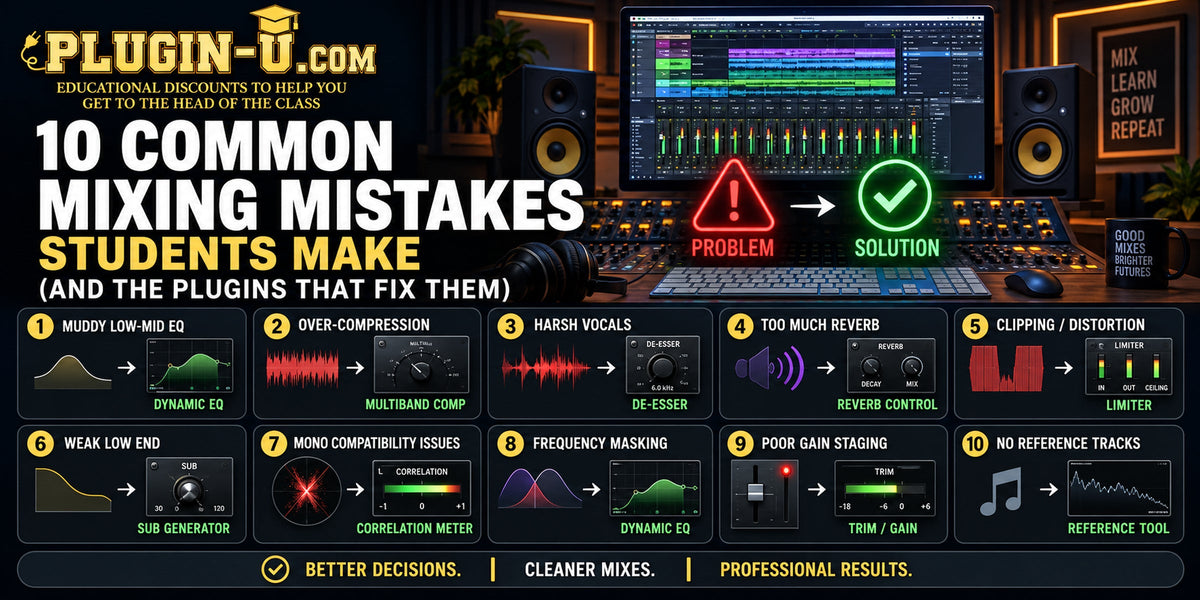
One of the biggest mistakes students make is buying massive plugin bundles before fully understanding:
- EQ,
- compression,
- gain staging,
- automation,
- and balance.
A smaller collection of well-understood premium tools is usually far more valuable than owning hundreds of plugins with no consistent workflow.
Plugin-U.com may help students compare plugin ecosystems and explore educational-discount eligibility before purchasing elsewhere.

Leave a comment
This site is protected by hCaptcha and the hCaptcha Privacy Policy and Terms of Service apply.